Patrons of Lam Rim Centres

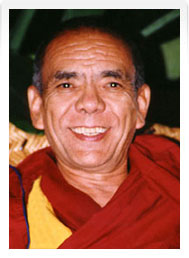
Khensur Denma Lochö Rinpoche

HE Denma Locho Rinpoche

Khensur Denma Lochö Rinpoche was born in Kham, eastern Tibet, in 1928. At the age of six he was recognised as the reincarnation of a famous yogi, Chöying Gyatso. He entered Drepung Loseling Monastery at the age of eleven.

Rinpoche received his Lharampa Geshe degree in 1953 (coming first in his class) and completed his Tantric exams at Gyume Tantric College in 1958. He received many teachings from the late Venerable Ling Rinpoche (the senior tutor to His Holiness the Dalai Lama) and became the main lineage holder of all his teachings.

After escaping to India in 1959 Rinpoche spent two years on a research fellowship at Calcutta University and was principle of the Buddhist School of Dialectics in Ladakh for six years. In 1967 he was abbot of a monastery in Manali before moving to Dharamsala where he now resides. He served as Abbot of Namgyal Monastery (the private monastery of his Holiness the Dalai Lama) from 1986 to 1991.

A Teaching given by Khensur Denma Lochö Rinpoche can be found at the bottom of this page. The Teaching was originally given at the Root Institute in Bodhgaya, India in 1995, translator Ven. Gareth Sparham. This Teaching appears by the kind permission of Khensur Denma Locho Rinpoche.


His Eminence, The Jangtse Chöje, Rizong Sre Rinpoche

HE Rizong Sre Rinpoche

His Eminence Rizong Rinpoche is one of the most highly respected lamas alive today.

Born in Ladakh, as an infant he was recognized and enthroned as the reincarnation of the Rizong Sre Tulku, and since that time has dedicated his life to the study and practice of the enlightenment path. He joined Drepung Loseling Monastery, Lhasa, in the mid-1940s. In Tibetan spiritual circles he is regarded as a modern-day Milarepa, having lived a life of simplicity and meditation since his youth. Recently he completed a strict three year retreat in a remote cave of Ladakh so inaccessible that it was snowed in for six months a year. In the past he has served as abbot of firstly the Gyume Tantric College and then Drepung Loseling Monastery.

At present he holds the post of Jangtse Chöje Rinpoche - (Dharma master of the Northern Peak), one of the three highest seats in the Gelukpa School.


The Two Truths? by Denmo Locho Rinpoche

Denmo Lochö Rinpoche, the ex-abbot of Namgyal, His Holiness the Dalai Lama's monastery in Dharamsala, India, taught for two weeks at Root Institute in Bodhgaya, India December 1995. Here is an extract. Translated by Ven. Gareth Sparham. This Teaching appears by the kind permission of our Patron, Khensur Denma Locho Rinpoche.

I have been asked to give a talk on the Two Truths: the conventional or surface level of truth and the ultimate truth. Looking at it one way it seems as if I've already finished my teaching because there are just these two words: conventional and ultimate, and that's finished! But in fact these two truths subsume within them all of Buddhism, so there is more to talk about than you'd find in a huge beak.

I ask all of you in this special place of Bodhgaya to bring up within you a special motivation. Every living creature, no matter who they are, are living creatures seeking happiness. At the same time they seek happiness, they are unaware of the cause of happiness, so call up this motivation: that to relieve them from their unhappiness, I must myself achieve all the wonderful qualities, all the excellence of an enlightened state, in order to teach them how to free themselves.

Living creatures, just like ourselves, are defined by seeking to avoid unpleasant, suffering situations, and seeking to place themselves in happy situations. Animals, from insects on up, have knowledge of methods to immediately remove suffering, they have this intelligence. The human being differs from the animal as they have the intelligence to take into account a much greater time span. They can begin to do things to alleviate states that they will otherwise experience a long time in the future - for example, getting a good education so we can find a job, make money, and live well in the future. At this point we are talking generally; spirituality hasn't entered into the discussion at all.

If one performs wholesome deeds, one's future will be in a happy state. If one has performed unwholesome deeds, one has set down the causes to find oneself in a state of woe. Spirituality then enters the thought process of a human being contemplating a future that goes beyond simple death.

Everything that the enlightened one spoke of leads back to the understanding of the two levels of truth. (This doesn't mean there is no third truth, for example the Four Noble Truths and so on, so you can have sub-divisions.) Since you have two levels of reality, you have to have something being sub-divided, or categorized in two categories.

So you can ask yourself, "What is being sub-divided?" and the answer is knowables or objects of knowledge (Tibetan, she-ja). Here, a knowable is simply something that is existing. To exist means to be knowable, and to be knowable means to exist.

For example, I could have the idea of antlers on a rabbit - it could come up in my mind. I could fabricate this awareness, and in that sense rabbit's antlers are something known but they certainly don't exist. [The problem] here is that when you equate things that exist and things that are known, they are known by [a valid] awareness but not by [just any] awareness. In other words I could get out of this difficulty by saying that, true, rabbit's antlers are known by [a particular person's] awareness, but this doesn't necessarily mean that they are known by awareness!

Ultimate truth, paramarthasatya, if you take the [Sanskrit] word apart is this: artha refers to that which is known; parama refers to that which knows its object, that is, the mind of a high spiritual being; satya means truth. It is truth because that which is known is true for that which knows its object, the mind of the high spiritual being, therefore, ultimate truth, an ultimate thing that is true.

So what about this other truth, the conventional, surface level of truth: how does one come to understand this second of the two truths if the ultimate reality is understood in this way? This is samvrtisatya. Samvrti is total covering up, and covering here means ordinary awareness covering that which is real. Here again satya is truth, but truth for an ordinary awareness. In other words, all the things that are true for ordinary minds like our own that are taken as real by them - are conventional truths, therefore, truth for an ordinary covering mind.

In the scholastic tradition we say that anything that is known will always be included in one of these two levels of reality. Anything not covered by these two levels is beyond the sphere of what is knowable. There is a deep logic here - that these two categories, the two truths, are an exhaustive description of all that there is.

Here is how it works. Truth and lie go together, don't they? If a person makes a statement that mirrors reality, then that statement is true. However, a statement not minoring reality is a lie.

The ultimate level of reality is mirrored in the mind of awareness that knows it, in a way that is not lying. This necessarily brings out the situation that all conventional truths are lying to the awareness that knows them, about the way they appear. Similarly, ordinary things appearing to ordinary awareness must be said to be lying to that ordinary awareness. You are, by removing that truth, positively showing the truth of the awareness of the ultimate. That ultimate, appearing to an awareness that knows it is not lying to that awareness, is the suchness of things - the ultimate reality of things.

So you have one being necessitated by another in a see-saw-like fashion, and from that account you can extrapolate out to show that it is a statement that is exhaustive knowables, of all that exists.

In Buddhist systems of ideas, tbere are many interpretations of what exactly theses two levels of truth are. They are set forth as the four Buddhist schools of philosophy.

In the most profound school, the Middle Way Consequentialist school, just what is emptiness or the ultimate? lt is this: that in fact nobody or nothing, anywhere, has anything that inherently makes it what it is. Nothing has its own personal mark. Everything exists simply through language, through ideas. The absence of something, the total absence, the total not-being, non-existense of anything that is not there through the power of language and thought is shunyata, emptiness, the ultimate truth.

When one talks of an ultimate truth, of emptiness, one has a focus; one is looking at objects and finding them to be totally empty. What one is looking at and finding to be empty is very important. The identification of things first becomes an important thing to do because the ultimate truth isn't something immediately apprehensible by our senses - we can't see it. We have to arrive at it through our thought processes, and in order to do this we have to use reasoning. This reasoning takes as its point of departure certain things or bases, so we must identify these in the first instance.

Let's start by trying to identify what are classically the most important of these bases, the five aggregates or skandas. In The Heart Sutra it says, "He looked and saw that the five aggregates are empty of inherent existence." So if you don't know what these five are, how can you look into the ultimate truth ofthem?? The five aggregates are: a great heap of physical things, a great heap of feelings, a great heap of discriminations, a great heap of created things (Sanskrit, samskara) and a great heap of awareness.

So then, one has heaps, aggregates, and these locate living creatures. Let's take the aggregate of physical things, which can be further broken down into the external objective physical things and the internal subjective physical things. Sights, sounds, smells, tastes and sensations are the external or objective physical things in this great heap of physical things, while the five senses are the subjective or internal physical things.

The second heap is that of feelings. What are feelings? They are the experiences one gets out of things: pleasant experiences, neutral experiences and unpleasant ones.

The next heap is discrimination, which is defined as that part of the mind that functions to identify particular things as what they are.

The fourth aggregate of created things has most of the non-associated created things. It's a catch-bag for everything not included in the other four heaps.

And what is the fifth heap? This is all our awarenesses or consciousness or thoughts. This is generally looked at as sense-based awareness coming from a thinking mind.

One can only focus on the reality of emptiness when one has seen the size, the dimensions, of what one is refuting or denying.

The Tibetan saint Tsong Khapa said, "Anything that is produced from conditions is never produced." You can unpack this apparent paradox in this way. What you are saying is that nothing is produced as something that is independent; nothing is produced as something that is there under its own power. That's what you are trying to demonstrate.

For example, a seedling isn't produced as something there under its own power, as something that is inherently what it is. Why? Because it is produced from causes and conditions. That's how you break down the meaning of the statement to formulate it as a reason for the hidden meaning, which is emptiness, to come clear to the mind.

Lama Tsongkhapa writes in his famous Praise to Dependent Arising, "What is more amazing, what better way of expressing a reality has ever been found? Namely that anything that depends on conditions is empty."

There are many different reasons a person can use to come to understand emptiness. But here we meet with the king of all reasonings - dependent arising - because being produced or arising dependently is the reason for everything's emptiness. Using this reason, one avoids the extreme of nihilism, because dependent arising shows something is there; nevertheless, because it is a reason that shows emptiness it also removes eternalism.

As the great Aryadeva said, "Anyone who gets a view into one reality gets a view into all realities." What he is saying is that if one plumbs the depths of reality of anything, one doesn't need to go through the whole process again with another object. Just bringing to the mind the reality you've seen in one object or person, and turning the mind to another, you will look at its reality as well.

That's why every one of our sadhanas without exception starts with the mantra that means "Om, this is purity, all Dharmas are pure, I am that purity." Before doing any sadhana one brings to mind this fact of the ultimate reality - of emptiness.